If giraffes were predators they would look both hilarious and terrifying while sneaking up on their prey
I’m afraid you’ve missed the predatory giraffes by about 66 million years mate.
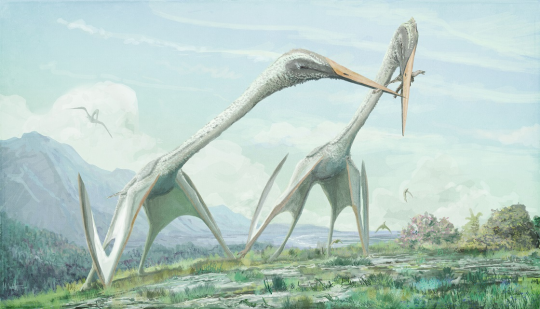
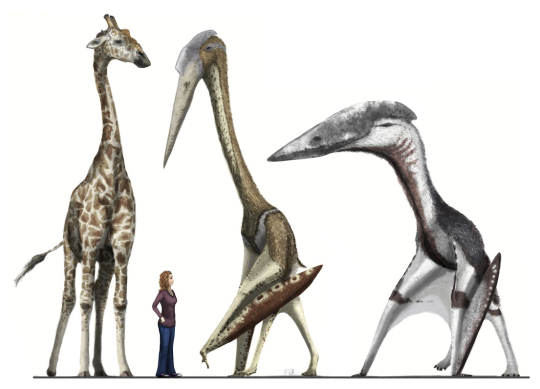
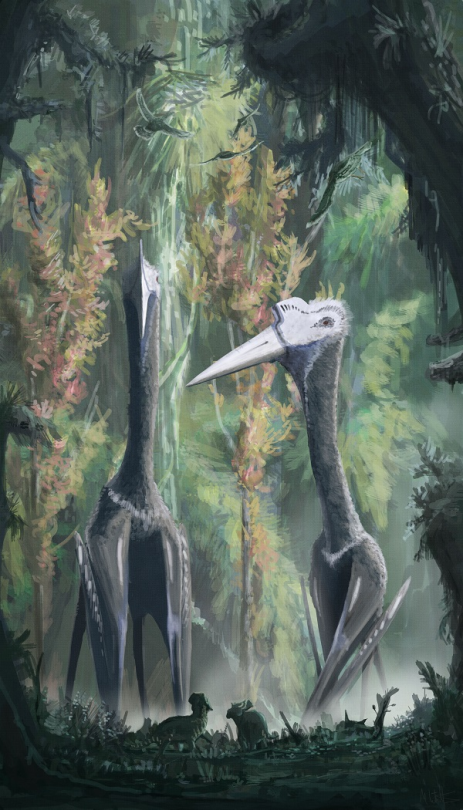
These guys are Azhdarchid pterosaurs, and they were some of the strangest reptiles to ever exist. They were perfectly capable of flight, but their physiology suggests that they may have spent a significant portion of their lives hunting on the ground.
The largest of them could reach over 5 metres tall while standing, and had a 10-metre wingspan. They varied greatly in body type, from the tall, spindly forms of Quetzalcoatlus and Arambourgiania (images 4 and 1-2 respectively) to the heavy brute strength of Hatzegopteryz, a species that may have used its head to bludgeon its prey (images 2 and 3).
There has never been another flying animal before or since to have reached such incredible sizes, nor any predator so intimidatingly tall. Well, not any that we know of yet.
All of these illustrations are by Mark Witton, a palaeontologist and artist who specialises in pterosaurs. This is his blog about palaeontology and the science of reconstructing extinct species. You can find out more about each of these images here, here and here.
A new chapter in the wild began today for 26 eastern indigo snakes reared at the Zoo in the latest milestone in a conservation partnership to restore a native species to its original range. In a collaboration between Zoo Atlanta, the Central Florida Zoo’s Orianne Center for Indigo Conservation and Auburn University, the snakes were released into the Conecuh National Forest near Andalusia, Alabama, on July 14, 2017.
Previously to the beginning of a reintroduction effort, the eastern indigo snake had not been sighted in the wild in Alabama in around 50 years. The snakes are a keystone species of the longleaf pine-wiregrass and sandhills ecosystem, and their reintroduction carries significant positive ecological benefits for the national forest.
Zoos are known for their conservation work on other continents around the world, but conservation begins in our own backyards. This is a notable example of a project that continues to have a direct impact on re-establishing an iconic species in its native range.
Our Zoo has reared more than 80 eastern indigo snakes for the reintroduction program, which is a cooperation among stakeholders throughout the Southeast. Additional project partners include the Alabama Department of Natural Resources, Georgia Department of Natural Resources, U.S. Fish and Wildlife Service, the Florida Fish and Wildlife Commission and The Nature Conservancy.
The newest group of reintroduced snakes had been reared here since 2015. As they had been designated for release into the wild, the young snakes received care and feeding in behind-the-scenes facilities where they had limited interactions with humans. In this environment, the snakes were able to grow to a size capable of avoiding many of the predators that feed on juvenile snakes.
Prior to their release, the snakes received passive integrated responder tags (PIT) for identification. Preliminary results from tracking efforts have shown that previous groups of reintroduced snakes are surviving, thriving, and reproducing.
To date, more than 100 eastern indigo snakes have been released into Conecuh National Forest, a majority of which have been reared at the Zoo. The goal of the project is to release 300 snakes over a 10-year period at an average of 30 snakes a year.
The largest nonvenomous snake species in North America and a native of southern Georgia, Florida, Alabama, South Carolina and Mississippi, the eastern indigo snake has declined across its historic range with the destruction of its ecosystem. This decline is also observed in Georgia’s state reptile, the gopher tortoise, which creates burrows that are often used by eastern indigo snakes and other species.
Eastern indigo snakes play an additional valuable role in their environment by keeping other snake populations in check, as they are known to eat venomous species, including copperheads. These snakes are not constrictors; instead, they overpower their prey using the crushing force of their jaws.
To learn more things people dont realize about zoos here ~>
One of my very favorite reptile species! It warms my heart to see captive breeding programs finally come to fruition and the animals in the programs get the chance to return to their homelands. Go with God, little reptiles. Your planet needs you!
Kudos to this mom visiting the San Diego Zoo for turning this amazing event into an educational experience and not a source of horror and fear.
This is so cool, and she explained it beautifully to the children. Everything has to eat. For my followers who need fair warning the komodo does catch, kill and eat a squirrel so if that makes you uncomfortable don’t watch.
i feel sad bc nobody knows me as the guy who loves crocodiles anymore i used to be so vocal about it. i still love them with all my heart those big boys!
crocodiles are filled with hate
you’re going to be filled with bullets if you keep running your mouth





 PiraticOctopus